
Mark P. Mills
About Mark P. Mills


Speech topics
The Intersection of Technology, Policy, and Markets
Speaking videos
Books by Mark P. Mills
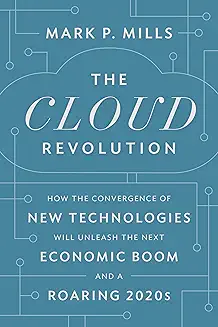
“The Cloud Revolution: How the Convergence of New Technologies Will Unleash the Next Economic Boom and A Roaring 2020s” (2021)
The conventional wisdom on how technology will change the future is wrong. Mark Mills lays out a radically different and optimistic vision for what's really coming. The mainstream forecasts fall into three camps. One considers today as the "new normal," where ordering a ride or food on a smartphone or trading in bitcoins is as good as it's going to get. Another foresees a dystopian era of widespread, digitally driven job- and business-destruction. A third believes that the only technological revolution that matters will be found with renewable energy and electric cars. But according to Mills, a convergence of technologies will instead drive an economic boom over the coming decade, one that historians will characterize as the "Roaring 2020s." It will come not from any single big invention, but from the confluence of radical advances in three primary technology domains: microprocessors, materials, and machines. Microprocessors are increasingly embedded in everything. Materials, from which everything is built, are emerging with novel, almost magical capabilities. And machines, which make and move all manner of stuff, are undergoing a complementary transformation. Accelerating and enabling all of this is the Cloud, history's biggest infrastructure, which is itself based on the building blocks of next-generation microprocessors and artificial intelligence. We've seen this pattern before. The technological revolution that drove the great economic expansion of the twentieth century can be traced to a similar confluence, one that was first visible in the 1920s: a new information infrastructure (telephony), new machines (cars and power plants), and new materials (plastics and pharmaceuticals). Single inventions don't drive great, long-cycle booms. It always takes convergent revolutions in technology's three core spheres--information, materials, and machines. Over history, that's only happened a few times. We have wrung much magic from the technologies that fueled the last long boom. But the great convergence now underway will ignite the 2020s. And this time, unlike any previous historical epoch, we have the Cloud amplifying everything. The next long boom starts now.

“Digital Cathedrals” (2019)
We are now witnessing the build-out of society’s first foundationally new infrastructure in nearly a century: the Cloud. It is an ecosystem of information-digital hardware, at the heart of which resides massive warehouse-scale datacenters unlike anything ever built. Given the resources committed to them and the reverence afforded to the companies that build and own them, datacenters might be called the digital cathedrals of the twenty-first century. The emerging Cloud is as different from the communications infrastructure that preceded it, as air travel was different from automobiles. And, using energy as a metric for scale—since there are only two kinds of infrastructures, energy-producing and energy-using—today’s global Cloud already consumes more energy than all aviation. Yet, as disruptive as the Cloud has already become, we are in fact just at the end of the beginning of what the digital masons are building for the twenty-first century.

“Work in the Age of Robots” (2018)
Are robots finally replacing humans? Does the emerging age of artificial intelligence and automation mean we will soon see “peak jobs” and the need for a Universal Basic Income to support a widening swath of hapless citizens unsuited for employment in a primarily “knowledge” workforce? Improving productivity—reducing labor hours per unit of product or service—has been the hallmark of economic progress for centuries. But advances due to robots and AI, some say, will be fundamentally different because digital machines are ready to revolutionize the nature of work in nearly every sector, not just one or two. But the lessons of history and the realities of technologies suggest that, despite yet more disruption, the overall result will be net job gains and faster economic growth.

“The Bottomless Well: The Twilight of Fuel, The Virtue of Waste, and Why We Will Never Run Out of Energy” (2005)
The sheer volume of talk about energy, energy prices, and energy policy on both sides of the political aisle suggests that we must know something about energy. But according to Peter Huber and Mark Mills, the things we "know" are mostly myths. In The Bottomless Well, Huber and Mills debunk the myths and show how a better understanding of energy will radically change our views and policies on a number of very controversial issues. They explain why demand will never go down, why most of what we think of as "energy waste" actually benefits us; why greater efficiency will never lead to energy conservation; and why the energy supply is infinite-it's quality of energy that's scarce and expensive. The Bottomless Well will also revolutionize our thinking about the automotive industry (gas prices don't matter and the hybrid engine is irrelevant), coal and uranium, the much-maligned power grid (it's the worst system we could have except for all the others), what energy supplies mean for jobs and GDP, and many other hotly debated subjects.
FAQs on Mark P. Mills
 At a glance
Mark P. Mills

Recommended offer:
Connect with an event specialist:
Get StartedBrowse Similar Speakers
Speaker Search is a marketplace of speakers designed for talent buyers. We do not represent or manage speakers; instead, we provide event planners with the most comprehensive resource to discover the right talent.