
Diana Butler Bass
About Diana Butler Bass


Speech topics
The Transformative Power of Giving Thanks
Speaking videos
Books by Diana Butler Bass

“Broken We Kneel Reflections on Faith and Citizenship” (2004)
Drawing on her personal experience as well as her knowledge of religious history, Diana Butler Bass examines the contours of the uniquely American relationship between church and state, Christian identity and patriotism, citizenship and congregational life. Broken We Kneel attempts to answer the central question that so many are struggling with in this age of terror: "To whom do Christians owe their deepest allegiance? God or country?" In writing both impassioned and historically informed, Bass, who lives outside of Washington, D.C., reflects on current events, personal experiences, and political questions that have sharpened the tensions between serious faith and national imperatives. This book incorporates the author's own rich experience of faith, her vocation as a writer and teacher, and her roles as wife, mother, and churchgoer into a larger conversation with Christian practice and contemporary political issues. Broken We Kneel is a call to remember that the core of Christian identity is not always compatible with national political policies.

“A Beautiful Year 52 Meditations on Faith, Wisdom, and Perseverance” (2025)
One of America’s most trusted theologians offers spiritual inspiration for every week of the year A Beautiful Year: 52 Meditations on Faith, Wisdom, and Perseverance offers an essay for every week in the seasons of the Christian year: From Advent and Christmas to Lent and Easter through the entire calendar. Other than its major holidays, many people are not familiar with the rhythms of the church year, an ancient spiritual cycle of time. Yet all religions have such calendars — and they shape our understanding of faith. In the West, we live in tension with the secular calendar (mostly an inheritance from the Roman Empire) and the Christian liturgical calendar, a cycle of sacred stories that compose a larger narrative of love, hospitality, mercy, justice, and gratitude. Bass reclaims and presents fresh perspectives for every biblical text in the church year; from musing on A Wrinkle in Time in Advent, to remembering her father’s old-fashioned blue Christmas decorations, and offering a revolutionary reading of the Last Supper. With fresh insights on familiar stories, these essays surprise and inspire, challenge and comfort, and will be savored year after year. Beautifully designed, the book is also a perfect gift.
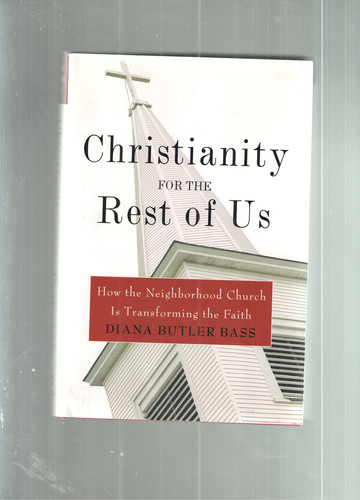
“Christianity for the Rest of Us: How the Neighborhood Church Is Transforming the Faith” (2006)
For decades the accepted wisdom has been that America's mainline Protestant churches are in decline, eclipsed by evangelical mega-churches. Church and religion expert Diana Butler Bass wondered if this was true, and this book is the result of her extensive, three-year study of centrist and progressive churches across the country. Her surprising findings reveal just the opposite—that many of the churches are flourishing, and they are doing so without resorting to mimicking the mega-church, evangelical style. Christianity for the Rest of Us describes this phenomenon and offers a how-to approach for Protestants eager to remain faithful to their tradition while becoming a vital spiritual community. As Butler Bass delved into the rich spiritual life of various Episcopal, United Methodist, Disciples of Christ, Presbyterian, United Church of Christ, and Lutheran churches, certain consistent practices—such as hospitality, contemplation, diversity, justice, discernment, and worship—emerged as core expressions of congregations seeking to rediscover authentic Christian faith and witness today. This hopeful book, which includes a study guide for groups and individuals, reveals the practical steps that leaders and laypeople alike are taking to proclaim an alternative message about an emerging Christianity that strives for greater spiritual depth and proactively engages the needs of the world.

“Standing Against the Whirlwind: Evangelical Episcopalians in Nineteenth-Century America” (1995)
Standing Against the Whirlwind is a history of the Evangelical party in the Episcopal Church in nineteenth-century America. A surprising revisionist account of the church's first century, it reveals the extent to which evangelical Episcopalians helped to shape the piety, identity, theology, and mission of the church. Using the life and career of one of the party's greatest leaders, Charles Pettit McIlvaine, the second bishop of Ohio, Diana Butler blends institutional history with biography to explore the vicissitudes and tribulations of evangelicals in a church that often seemed inhospitable to their version of the Gospel. This gracefully written narrative history of a neglected movement sheds light on evangelical religion within a particular denomination and broadens the interpretation of nineteenth-century American evangelicalism as a whole. In addition, it elucidates such wider cultural and religious issues as the meaning of millennialism and the nature of the crisis over slavery.

“Grateful the Subversive Practice of Giving Thanks” (2019)
If gratitude is good, why is it so hard to do? In Grateful, Diana Butler Bass untangles our conflicting understandings of gratitude and sets the table for a renewed practice of giving thanks. We know that gratitude is good, but many of us find it hard to sustain a meaningful life of gratefulness. Four out of five Americans report feeling gratitude on a regular basis, but those private feelings seem disconnected from larger concerns of our public lives. In Grateful, cultural observer and theologian Diana Butler Bass takes on this “gratitude gap” and offers up surprising, relevant, and powerful insights to practice gratitude. Bass, author of the award-winning Grounded and ten other books on spirituality and culture, explores the transformative, subversive power of gratitude for our personal lives and in communities. Using her trademark blend of historical research, spiritual insights, and timely cultural observation, she shows how we can overcome this gap and make change in our own lives and in the world. With honest stories and heartrending examples from history and her own life, Bass reclaims gratitude as a path to greater connection with god, with others, with the world, and even with our own souls. It’s time to embrace a more radical practice of gratitude—the virtue that heals us and helps us thrive.
FAQs on Diana Butler Bass
 At a glance
Diana Butler Bass

Recommended offer:
Connect with an event specialist:
Get StartedBrowse Similar Speakers
Speaker Search is a marketplace of speakers designed for talent buyers. We do not represent or manage speakers; instead, we provide event planners with the most comprehensive resource to discover the right talent.