
James Paul Gee
About James Paul Gee


“I have spent a good portion of my adult life admiring the work of James Paul Gee, and it turns out that the in-person experience was even more wonderful than I could have imagined. James is a good human, as well as a great mind.”
Speech topics
Discourse
Speaking videos
Books by James Paul Gee

“What Is a Human : Language, Mind, and Culture” (2020)
In a sweeping synthesis of new research in a number of different disciplines, this book argues that we humans are not who we think we are. As he explores the interconnections between cutting-edge work in bioanthropology, evolutionary biology, neuroscience, human language and learning, and beyond, James Paul Gee advances, also, a personal philosophy of language, learning, and culture, informed by his decades of work across linguistics and the social sciences. Gee argues that our schools, institutions, legal systems, and societies are designed for creatures that do not exist, thus resulting in multiple, interacting crises, such as climate change, failing institutions, and the rise of nationalist nationalism. As Gee constructs an understanding of the human that takes into account our social, collective, and historical nature, as established by recent research, he inspires readers to reflect for themselves on the very question of who we are—a key consideration for anyone interested in society, government, schools, health, activism, culture and diversity, or even just survival.

“An Introduction to Discourse Analysis” (2014)
Discourse analysis considers how language, both spoken and written, enacts social and cultural perspectives and identities. Assuming no prior knowledge of linguistics, An Introduction to Discourse Analysis examines the field and presents James Paul Gee’s unique integrated approach which incorporates both a theory of language-in-use and a method of research. An Introduction to Discourse Analysis can be used as a stand-alone textbook or ideally used in conjunction with the practical companion title How to do Discourse Analysis: A Toolkit. Together they provide the complete resource for students studying discourse analysis. Updated throughout, the fourth edition of this seminal textbook also includes two new chapters: ‘What is Discourse?’ to further understanding of the topic, as well as a new concluding section. A new companion website www.routledge.com/cw/gee features a frequently asked questions section, additional tasks to support understanding, a glossary and free access to journal articles by James Paul Gee. Clearly structured and written in a highly accessible style, An Introduction to Discourse Analysis includes perspectives from a variety of approaches and disciplines, including applied linguistics, education, psychology, anthropology and communication to help students and scholars from a range of backgrounds to formulate their own views on discourse and engage in their own discourse analysis. This is an essential textbook for all advanced undergraduate and postgraduate students of discourse analysis.
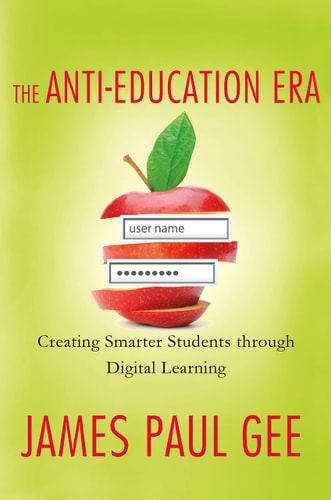
“The Anti-Education Era: Creating Smarter Students through Digital Learning” (2013)
Today's schools are eager to use the latest technology in the classroom, but rather than improving learning, the new e-media can just as easily narrow students' horizons. Education innovator James Paul Gee first documented the educational benefits of gaming a decade ago in his classic What Video Games Have to Teach Us About Learning and Literacy. Now, with digital and social media at the center of modern life, he issues an important warning that groundbreaking new technologies, far from revolutionizing schooling, can stymy the next generation's ability to resolve deep global challenges. The solution-and perhaps our children's future-lies in what Gee calls synchronized intelligence, a way of organizing people and their digital tools to solve problems, produce knowledge, and allow people to count and contribute. Gee explores important strategies and tools for today's parents, educators, and policy makers, including virtual worlds, artificial tutors, and ways to create collective intelligence where everyday people can solve hard problems. By harnessing the power of human creativity with interactional and technological sophistication we can finally overcome the limitations of today's failing educational system and solve problems in our high-risk global world. The Anti-Education Era is a powerful and important call to reshape digital learning, engage children in a meaningful educational experience, and bridge inequality.

“Social Linguistics and Literacies: Ideology in Discourses, 4th Edition” (2012)
In its first edition, Social Linguistics and Literacies was a major contribution to the emerging interdisciplinary field of sociocultural approaches to language and literacy, and was one of the founding texts of the ‘New Literacy Studies’. This book serves as a classic introduction to the study of language, learning and literacy in their social, cultural and political contexts. It shows how contemporary sociocultural approaches to language and literacy emerged.
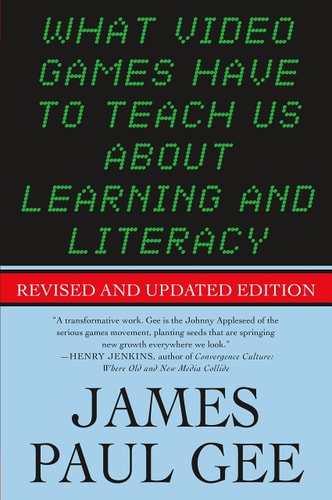
“What Video Games Have to Teach Us About Learning and Literacy” (2007)
James Paul Gee begins his classic book with "I want to talk about video games--yes, even violent video games--and say some positive things about them." With this simple but explosive statement, one of America's most well-respected educators looks seriously at the good that can come from playing video games. In this revised edition of What Video Games Have to Teach Us About Learning and Literacy, new games like World of WarCraft and Half Life 2 are evaluated and theories of cognitive development are expanded. Gee looks at major cognitive activities including how individuals develop a sense of identity, how we grasp meaning, how we evaluate and follow a command, pick a role model, and perceive the world.
FAQs on James Paul Gee
 At a glance
James Paul Gee

Recommended offer:
Connect with an event specialist:
Get StartedBrowse Similar Speakers
Speaker Search is a marketplace of speakers designed for talent buyers. We do not represent or manage speakers; instead, we provide event planners with the most comprehensive resource to discover the right talent.